How to Tell If Moissanite Is Real: Conductivity, Double Refraction and Heat Checks
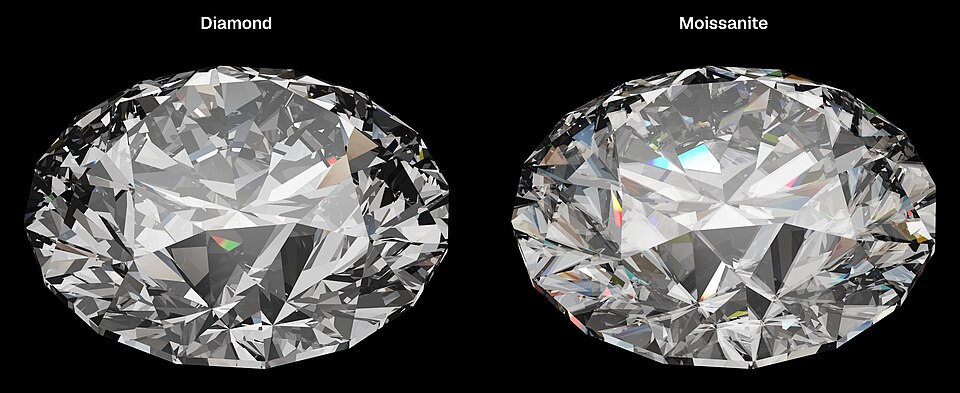
Moissanite is a widely used diamond alternative, and that raises two practical questions. Is the stone you bought as moissanite really that material, and could a stone sold to you as a diamond actually be moissanite? Both questions can be answered, but not with the tools most people try first. A standard pen-style diamond tester is often the wrong instrument for this job. The cut and setting give no clue either, because moissanite is shaped and mounted much like diamond. This guide explains what real moissanite is, which checks separate it from diamond, and how each check works. It also covers what can go wrong and when to hand the stone to a jeweler or gemologist.
Quick answer: A stone is real moissanite when it is the genuine mineral, which is almost always lab-grown. Simple heat-based diamond testers can mistake it for diamond, so confirm it with an electrical conductivity tester, which reads higher for moissanite, or by seeing its double refraction, ideally with a jeweler.
What counts as real moissanite
Moissanite is a mineral made of silicon carbide [1], written chemically as SiC [2]. A stone is real moissanite when it is that material. It does not matter whether the stone formed in nature or in a laboratory. What matters is whether the stone in your hand is the substance it is being sold as.
The mineral was first identified in 1893 [2] by the French chemist Henri Moissan, who found tiny crystals in rock from a meteorite impact site. The mineral was later named in his honor. Natural crystals turned out to be scarce and small, far too rare to supply a jewelry trade. Gem-quality moissanite became possible only once it could be grown in a lab, and it entered the jewelry market in 1998 [2]. The moissanite you see in engagement rings, studs and tennis bracelets is lab-created.
It is also very hard, at 9.5 [2] on the Mohs scale. That is why it keeps crisp facet edges and a bright polish through daily wear. Its durability and strong brilliance are the reasons it is so often cut in the same shapes as diamond and set in the same styles.
When people ask whether moissanite is real, they usually mean one of three things:
- A stone sold as moissanite might really be cubic zirconia, glass or another simulant.
- A stone sold as diamond might really be moissanite.
- An inherited or secondhand piece has no paperwork, and the owner wants to know what it is.
The first two are questions of substitution and misrepresentation. The third is plain identification. The checks below help with all three, but they focus on the hardest split: moissanite versus diamond.
Why a basic diamond tester can mislead you
Many jewelers and hobbyists own a small pen-shaped diamond tester. Most of the older and simpler models work by measuring how quickly heat travels from a warmed tip into the stone. Diamond carries heat away very efficiently, so the device signals a diamond when it detects that behavior.
The problem is that moissanite behaves in a similar way. Equipment that relies on thermal conductivity in particular can produce results that look like diamond [2]. In other words, a moissanite can pass a thermal-only test as if it were a diamond. This is how a mistake can happen in a secondhand sale: someone runs a heat-based tester, sees a diamond reading and stops there.
What this means for you:
- A diamond reading on a thermal-only tester does not prove a stone is diamond.
- A diamond reading on a thermal-only tester does not rule out moissanite.
- If moissanite versus diamond is the question, you need a different kind of measurement or an optical check, described in the next sections.
You may be working from the other direction and want to confirm that a stone is genuinely diamond. In that case, the companion guide on how to tell if a diamond is real covers the diamond side of the same problem. Read the two together, because a check that exposes moissanite also helps clear a true diamond.
Electrical conductivity: the practical moissanite test
The more workable approach is to measure electrical conductivity, where moissanite gives higher readings than diamond [2]. Dedicated moissanite testers are built around this principle, and many jewelers keep one at the counter precisely because a heat reading alone cannot settle the question.
How to read the result:
- A higher electrical conductivity reading points to moissanite.
- A low reading fits diamond, but on its own it is not proof. Back it up with the birefringence check in the next section.
- A reading that is unclear or changes from one attempt to the next is a job for a gemologist.
To get a clean reading:
- Ask the jeweler to keep the probe on the face of the stone and off the metal setting. Metal conducts electricity and can confuse the result.
- If the reading is borderline or flickers, have the stone tested again rather than accepting the first signal.
- In a multi-stone piece, test more than one stone. A ring can combine a moissanite center with side stones of a different material.
- Make sure the stone is clean and dry. Ask the jeweler to wipe it before testing, since residue on the surface sits between the probe and the stone.
Conductivity testing is quick and does not harm the stone. That is why it is usually the first serious check a jeweler runs when moissanite is suspected. It also works on most mounted stones, so the piece rarely needs to leave its setting for this step.
Birefringence: looking for doubled facets
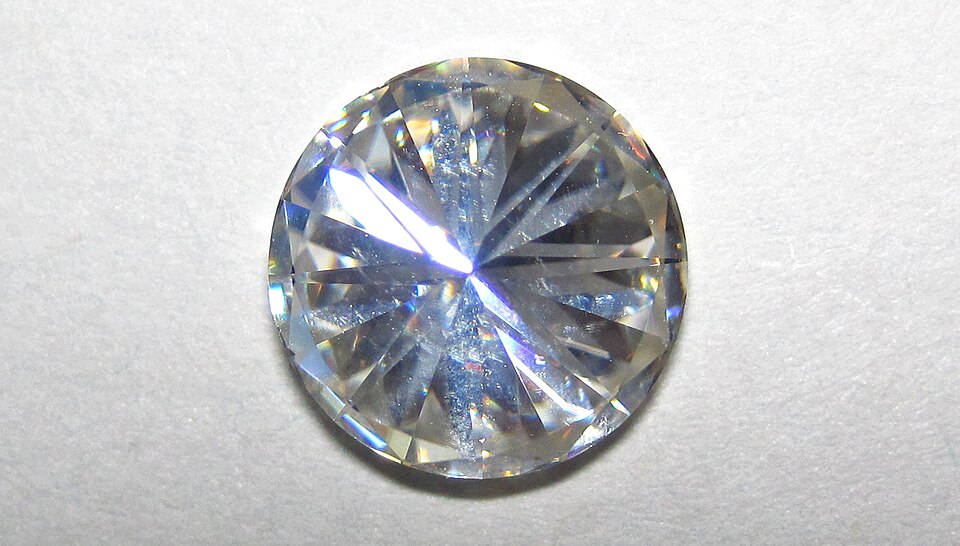
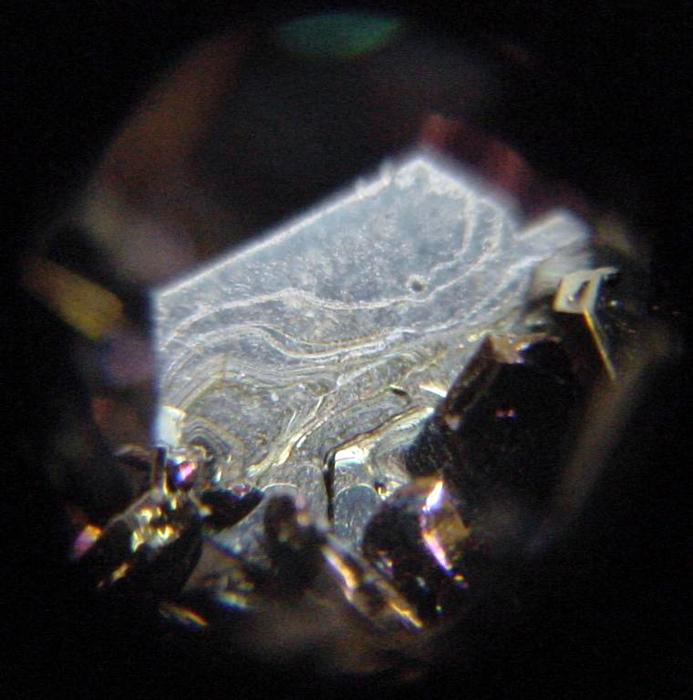
The second strong clue is optical. Moissanite is birefringent: light passing through it splits in two, and each part travels differently depending on its polarization. The effect is easy to see, and diamond does not show it [2]. Gemologists call this property double refraction.
In practice, birefringence shows up as doubling. Look through the stone toward the facets on the far side, and each facet edge can appear as two closely spaced lines instead of one. Under magnification, the back facet junctions look slightly ghosted, as if the image had been printed twice. A diamond viewed the same way shows single, crisp edges.
Tip: Do not look only straight down through the flat top facet. Cutters often orient moissanite so that doubling is least visible from that direction. Instead, tilt the stone and look through one of the side facets at an angle, using a jeweler's loupe and good light. The doubled lines are usually easiest to spot along the edges where the lower facets meet.
This check has two clear advantages. It needs no electricity and no contact with the stone. It also works on a mounted stone, as long as you can see into it. Its limitation is that some stones are hard to read, including small stones, heavily included stones and stones set deep in a bezel. Recognizing doubling also takes some practice. If you cannot decide whether you are seeing doubling, treat the result as inconclusive rather than as a pass.
Thermochromism: a temporary color shift under heat
A third difference appears with heat. Unlike diamond, moissanite is thermochromic: warm it gradually and its color shifts for a time before returning to normal [2]. Diamond does not respond this way.
This property is mainly useful as a confirmation in a controlled setting. A gemologist working on a loose stone can warm it carefully, watch for the shift, and let it cool without risk to anything else. The behavior is distinctive, so seeing it adds weight to a conductivity or birefringence result.
Warning: Do not try this on finished jewelry at home with a lighter, stove or torch. Sudden or uneven heat can crack gemstones and burn pearls and other organic materials. It can also soften glue in set or backed stones, loosen solder and discolor metal. A ring with a moissanite center may hold side stones that cannot take heat at all. A repair or a replacement stone can easily outweigh the benefit of getting an answer a few days sooner.
If heat testing seems necessary, ask the jeweler whether the stone can be removed from its setting first. Let a professional decide whether the check is worth doing at all. In most cases, conductivity and birefringence together give a clear answer without it.
Comparing the four moissanite checks
The four checks differ in what they tell you and in who should run them. The table below sets them side by side.
| Check | What moissanite shows | What diamond shows | Best run by |
|---|---|---|---|
| Thermal conductivity | A reading similar to diamond | A diamond reading | Anyone with a tester, but never on its own |
| Electrical conductivity | Higher readings | Lower readings | A jeweler with an electrical conductivity tester |
| Birefringence | Doubled facet edges | Single, sharp edges | Anyone with a loupe and some practice |
| Thermochromism | Temporary color change when heated gradually | No such color change | A gemologist, on a loose stone |
Here is how to read the table. On a thermal tester, moissanite gives readings similar to diamond [2], so this check groups the two stones together rather than separating them. Electrical conductivity reads higher for moissanite [2], which makes it the practical separating test. Moissanite shows doubled facet edges from birefringence, while diamond shows none [2]. That makes birefringence the check you can learn to do yourself. Thermochromism, the temporary color change under gradual heating [2], belongs on a lab bench, not a kitchen table.
A sensible order is to start with the non-contact optical check. Follow it with an electrical conductivity reading at a jeweler, and reserve heat for cases where the first two disagree. Two independent methods that agree are much stronger evidence than any single reading.
Common mistakes when checking a stone
Most wrong answers come from a short list of avoidable errors:
- Trusting one thermal reading. A heat-based tester can treat moissanite much like diamond [2], so a single signal proves little.
- Relying on the label. A seller's description, a branded box or a card in the case is a claim about the stone, not a test result.
- Calling an unclear result a pass. If you cannot tell whether facet edges look doubled, or a tester reading wavers, the honest answer is that the stone is not yet identified.
- Heating mounted jewelry, which can damage stones, glue and metal.
- Assuming lab-created means fake. Lab-grown moissanite is still moissanite. The question is what the stone is, not where it formed.
- Testing only the center stone. Side stones and accents can be different materials from the main stone.
That last point matters more than people expect. A ring or pendant sold as moissanite may carry colored accents, and each one raises its own identification questions. Red or orange side stones are covered in the guides on how to tell if a garnet is real and how to tell if a hessonite is real. Green accents may call for how to tell if a demantoid is real. Yellow stones are covered in how to tell if a citrine is real.
Another common slip is mixing up two different questions: 'Is this moissanite?' and 'Is this a well-made moissanite?' Identification tells you the material. It says nothing about cut quality, color or how securely the stone is set. Keep the two apart when you read a tester result or a seller's description.
When to ask an expert, and keeping a record
Checks at home are useful for narrowing things down. Some situations, though, call for a professional from the start:
- Buying or selling a stone where the difference between diamond and moissanite matters to the deal.
- An inherited or secondhand piece with no paperwork.
- Results that disagree, such as a diamond reading on a thermal tester alongside visible doubling.
- A stone you suspect a seller has misrepresented.
- Any case where heat testing or removing the stone from its setting might be needed.
A jeweler with an electrical conductivity tester can usually run that check while you wait. For a written identification, use an independent gemological laboratory. This matters most when the stone will be insured, resold or divided in an estate.
Whatever the outcome, write it down. Note who tested the stone, which method they used, what the reading was and when the test took place. Keep these notes with clear photos of the piece taken from several angles. If the stone is ever questioned again, that record saves you from starting over.
Jewelry Identifier can help with the record-keeping side. Its gemstone identifier gives a first look at a stone's type, cut and color from a photo. You can also save each piece to a personal catalog with notes, tags and photos, including your test results. A photo cannot prove that a stone is moissanite rather than diamond or cubic zirconia. Treat the app as a starting point and an organizer, and rely on hands-on testing and a professional for the final answer.
Common questions
- Is lab-created moissanite real moissanite?
- Yes. Lab-created moissanite has the same chemical makeup and crystal structure as the natural mineral, and nearly all moissanite in jewelry is made this way. A stone only stops being real moissanite if it is a different material sold under that name.
- Does the shape or cut of a stone tell me whether it is moissanite?
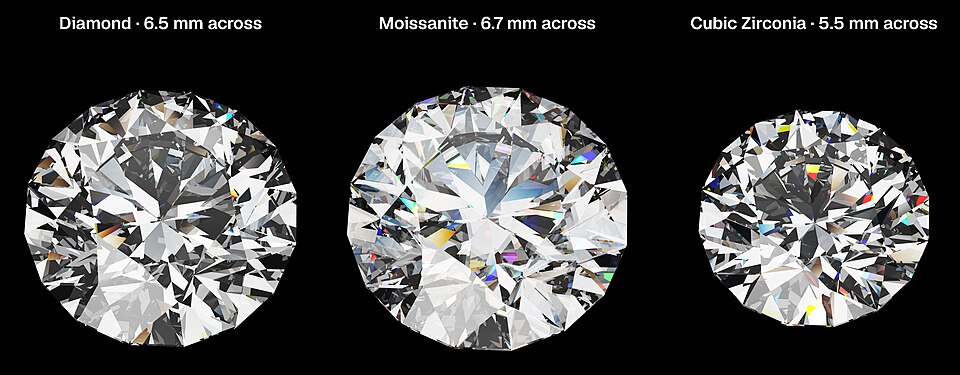
- No. Moissanite is cut in the same round, oval, cushion and other shapes used for diamond, and it is set in the same styles. The cut tells you how the stone was shaped, not what it is made of, so identification still needs proper testing.
- Can a photo prove that a stone is moissanite?
- No. A photo can suggest the type of stone and show its cut and color. It cannot confirm whether a clear stone is moissanite, diamond or cubic zirconia, which takes hands-on testing by someone with the right equipment.
- Should I test a stone myself before selling it?
- You can examine it closely out of interest, but for a sale it is better to have a jeweler or gemological laboratory identify it. A buyer will trust an independent result more than a home check, and a professional can test without risking damage to the piece.
- Does moissanite scratch or wear down over time?
- Moissanite is very hard and keeps its polish well in everyday wear. A sharp knock against a hard surface can still chip it, so store it apart from other pieces. Have the setting checked from time to time to make sure the stone is secure.
- What should I bring when I ask a jeweler to identify a stone?
- Bring the piece itself, any receipt or description from the seller, and notes on any testing already done. Tell the jeweler whether the stone was sold as moissanite or as diamond, because that shapes the questions they need to answer.
- Is moissanite the same as cubic zirconia?
- No. They are different materials with different compositions and properties. Both are used as diamond alternatives, which is why one is sometimes passed off as the other, and why identification matters when a stone is sold under either name.